
Drone Propeller Direction: How a Quadcopter Works
A quadcopter has no rudder, no ailerons and no tilting rotor heads. Every move it makes, from a steady hover to a fast banked turn, comes from changing the speed of four fixed propellers. That only works because the propellers spin in a specific pattern and the flight controller adjusts each motor hundreds or thousands of times a second.
This guide explains which way each propeller spins and why, how differential thrust produces yaw, pitch and roll, and how to fit props correctly on a camera drone or an FPV quad. If you get the direction wrong, the drone will flip or spin on takeoff, so it is worth understanding properly.
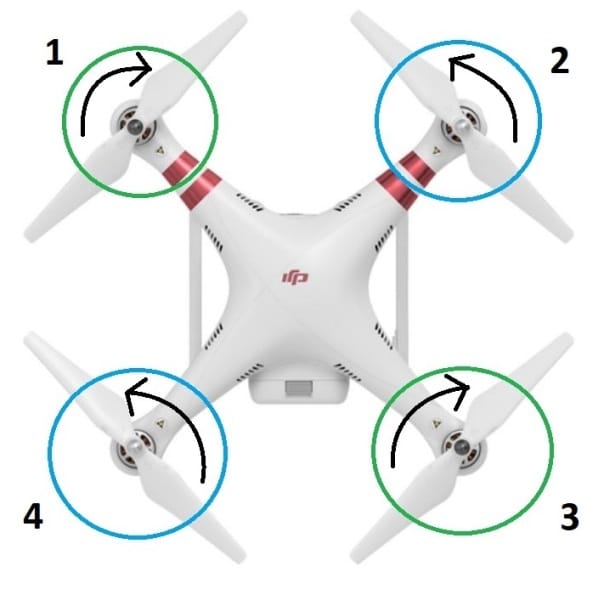
Quick answer: On a standard X quadcopter, diagonal motors spin the same way. Viewed from above, front-left and rear-right spin clockwise (CW), and front-right and rear-left spin counter-clockwise (CCW). The two pairs cancel each other’s torque so the drone does not spin. Speeding up one pair and slowing the other turns (yaws) the drone, while changing front/rear or left/right speeds tilts it to pitch or roll.
How a quadcopter flies: the basic idea
Each of the four rotors on a quadcopter is a motor with a propeller. (If you are here for the crossword clue “the ______ on a quadcopter each consist of a motor and a propeller”, the six-letter answer is rotors.) Each rotor pushes air down and, by Newton’s third law, the air pushes the rotor up. That upward force is thrust.
The props are fixed pitch, so the only thing the drone can change is how fast each one spins. More rpm means more thrust. The flight controller reads the pilot’s stick inputs and its own sensors, works out the thrust each corner needs, and sends a speed command to each motor’s electronic speed controller (ESC).
- Hover: total thrust equals the drone’s weight.
- Climb: all four motors speed up so thrust exceeds weight.
- Descend: all four slow down so thrust is less than weight.
The same chain of sensors, controller, ESCs and motors runs on every multirotor, from a toy to an enterprise drone. Our guide to how drone technology works covers the wider system, including GPS, radio links and cameras.
Drone propeller direction diagram explained
A spinning propeller does two things. It produces thrust, and it produces a reaction torque. The motor has to push against air drag to keep the prop turning, and the equal and opposite reaction tries to rotate the motor, and therefore the whole drone, the other way.
A helicopter cancels this with a tail rotor. A quadcopter cancels it by spinning two props clockwise and two counter-clockwise. When all four spin at the same speed, the torques balance and the drone holds its heading. The two directions are arranged on the diagonals so the craft also stays balanced in pitch and roll.
| Motor position (viewed from above) | Spin direction | Prop needed |
|---|---|---|
| Front left | Clockwise (CW) | CW prop |
| Front right | Counter-clockwise (CCW) | CCW prop |
| Rear left | Counter-clockwise (CCW) | CCW prop |
| Rear right | Clockwise (CW) | CW prop |
“Props in” means that, seen from above, the front edge of each front prop sweeps inward toward the drone’s centre line. Betaflight uses this as its default. The opposite layout, “props out”, simply reverses all four motors. Both work, because the diagonal pairing is the same and torque still cancels.
Hexacopters and octocopters
Larger multirotors follow the same rule. On a flat hexacopter or octocopter, the direction alternates CW, CCW, CW, CCW as you go round the frame. Coaxial designs (two props stacked on each arm) put one CW and one CCW prop on each motor pair.
How yaw, pitch and roll work on a quadcopter
All three rotations come from differential thrust: some motors speed up while others slow down. The flight controller keeps the total thrust roughly constant so the drone does not climb or sink while it turns or tilts.
Yaw (turning the nose left or right)
Yaw uses the torque imbalance on purpose. To turn right (clockwise seen from above), the controller speeds up the two CCW props and slows the two CW props. The extra reaction torque from the CCW props twists the frame clockwise. Total lift stays the same because two motors gain what the other two lose.
Yaw relies on drag torque, which is much weaker than thrust. That is why quadcopters often yaw more slowly than they pitch or roll, and why yaw can feel soft on small drones with low-torque motors.
Pitch (forward and backward)
To fly forward, the rear motors speed up and the front motors slow down. The nose dips and the whole thrust vector tilts forward. Part of the thrust now pushes the drone horizontally, so the controller raises total thrust slightly to stop it losing height. Flying backward is the reverse.
Roll (sideways)
Roll works the same way across the other axis. To move right, the two left motors speed up and the two right motors slow down, so the drone banks right and slides in that direction.
| Manoeuvre | Motors that speed up | Motors that slow down |
|---|---|---|
| Climb | All four | None |
| Pitch forward | Rear left, rear right | Front left, front right |
| Roll right | Front left, rear left | Front right, rear right |
| Yaw right (CW) | Front right, rear left (CCW pair) | Front left, rear right (CW pair) |
| Yaw left (CCW) | Front left, rear right (CW pair) | Front right, rear left (CCW pair) |
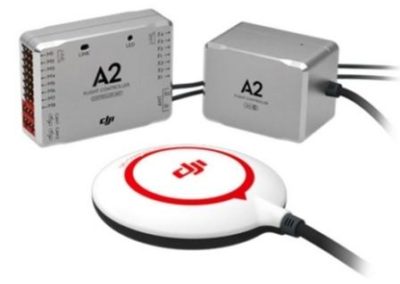
In practice the pilot never commands individual motors. A mixer in the flight controller blends throttle, yaw, pitch and roll into four motor outputs, and stabilisation loops based on the gyro correct errors in real time. Our explainer on drone gyros, IMUs and flight controllers covers how that feedback loop works.
Why do drones have 4 propellers?
Four is the smallest number of fixed-pitch rotors that gives full control with no extra moving parts. Two CW and two CCW props cancel torque, and the square layout lets the controller tilt the drone on both axes and yaw it using only motor speed.
- Tricopters (three rotors) cannot balance torque with speed alone, so they tilt the rear motor with a servo to yaw.
- Quadcopters are mechanically simple, light and efficient for their size, which is why almost every consumer and FPV drone uses four rotors.
- Hexacopters and octocopters carry heavier payloads and can often land safely if one motor fails, which matters for cinema and industrial work.
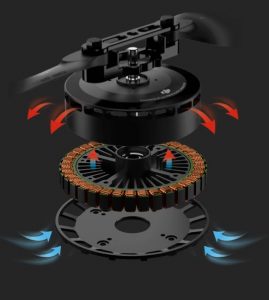
Motors, Kv and how they pair with propellers
Almost all modern drones use brushless outrunner motors. The outer bell, which holds permanent magnets, spins around fixed copper windings. The ESC switches current through the windings in sequence to keep the bell turning. There are no brushes to wear out, so brushless motors are more efficient and last longer than the brushed motors still found in some toy drones.
A brushless motor can run either way. Direction is set by the order of the three motor wires or, more often now, in ESC or flight controller software. That is why the propeller, not the motor, is the part you must match carefully.
- Kv rating: roughly the unloaded rpm per volt. A 2,000 Kv motor on a 16.8 V pack would spin at about 33,600 rpm with no prop fitted.
- High Kv, small props: fast and responsive, common on 5-inch FPV quads.
- Low Kv, large props: slower, more efficient and smoother, used on camera, mapping and heavy-lift drones.
For more on stators, windings and ESC protocols, read our guide to drone motors and ESCs.
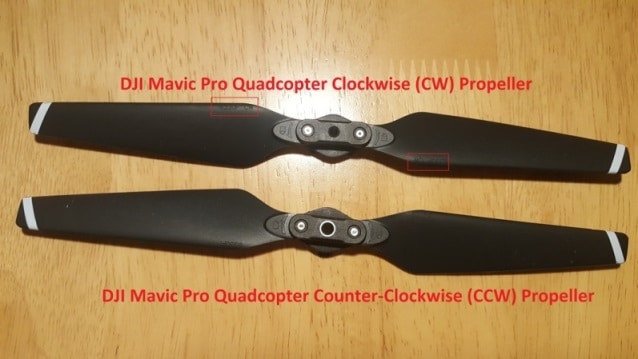
Propeller design: size, pitch, blades and markings
A CW prop and a CCW prop are mirror images. Each blade has a thicker, rounded leading edge and a thinner trailing edge, and the blade twists so it bites into the air in one direction only. Fit a prop on the wrong motor and it pushes air up instead of down.
- Diameter: the tip-to-tip length in inches. Bigger props move more air per revolution.
- Pitch: how far the prop would move forward in one turn, in inches. Higher pitch gives more speed but draws more current.
- Blade count: two-blade props are efficient; three-blade props give more grip and are standard on FPV quads.
- Notation: a “5×4.3×3” or “5143” prop is 5.1 inches in diameter, 4.3 inches pitch, three blades.
- Mounting: camera drones use quick-release or screw-on props; FPV quads usually use a 5 mm shaft with a lock nut, or a T-mount on small builds.
Materials matter too. Most consumer props are glass-filled nylon or polycarbonate, which bend rather than shatter. Carbon fibre props are stiffer and more efficient but more dangerous in a crash, so they are used mainly on larger professional drones.
How to fit drone propellers in the right direction
Camera drones make this hard to get wrong, but it still happens, especially after buying third-party props. FPV builds need more care because you set motor direction yourself.
- Check the markings. DJI drones use marked and unmarked props that match marks on the motors. FPV props are usually labelled CW/CCW or with an “R” for reversed.
- Check the shape. The leading edge (thick, rounded side) must lead in the direction the motor spins.
- Writing faces up. On most props the printed size and logo sit on the top surface.
- Verify motor direction first on FPV builds. Use the Betaflight motors tab with props removed, and reverse a motor in ESC software if needed.
- Tighten correctly. Self-tightening props thread opposite to the motor’s spin so they lock on in flight. Lock nuts should be firm but not crushed.
If a quad flips the instant it arms, the cause is almost always a prop on the wrong motor, a motor spinning the wrong way, or a flight controller set to the wrong orientation or motor order. If it spins on the spot, a pair of props is probably swapped. Our guide to FPV flying and equipment covers the rest of a typical quad build.
To see how propellers fit alongside the frame, battery, flight controller and camera, read our overview of the parts of a drone. If you want to experiment safely, the best educational drone kits let you build and program a quadcopter from scratch.
FAQs
Which way do drone propellers spin?
Two spin clockwise and two counter-clockwise, with each diagonal pair spinning the same way. In the common props-in layout, front-left and rear-right are CW and front-right and rear-left are CCW, viewed from above.
What happens if I put a drone propeller on the wrong motor?
That rotor pushes air the wrong way and produces little or negative thrust. The drone will usually flip over as it tries to take off. Camera drones may refuse to launch or show a motor error. Power off, check the markings and swap the prop.
Is props in or props out better for FPV?
Neither is better in every case. Props in is the Betaflight default and works well on most 5-inch quads. Some pilots prefer props out on tiny whoops for slightly better yaw response, and because the props tend to bounce off gates and branches. Pick one and set the flight controller to match.
How does a quadcopter turn without a tail rotor?
It speeds up one diagonal pair of props and slows down the other. The torque from the two directions no longer cancels, so the frame rotates. Total thrust stays the same, so the drone turns on the spot without climbing or sinking.