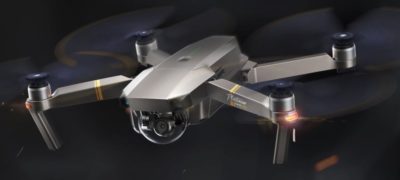

Drone Components: Parts of a Drone and What They Do
Every drone, from a palm-sized selfie drone to an FPV racer or a survey aircraft, is built from the same handful of systems. There is a frame, a way to make lift, a battery, a flight controller with sensors, a radio link and usually a camera on a gimbal. Knowing what each part does makes it much easier to choose a drone, fix one, or build your own.
This guide lists the main drone components, explains how they work together, and gives practical checks for each one.
Quick answer: The main components of a drone are the frame and arms, brushless motors, propellers, electronic speed controllers (ESCs), a flight controller with an IMU (gyroscope and accelerometer), GPS and compass, a radio receiver and antennas, a LiPo or Li-ion battery, and a camera on a stabilising gimbal. Many drones also carry obstacle sensors and a video transmitter.
Drone components list at a glance
The table groups the parts of a drone by job. Ready-to-fly camera drones hide most of these inside a sealed body, while FPV and DIY drones expose them as separate boards and modules you can replace.
| Component | What it does | What to check |
|---|---|---|
| Frame and arms | Holds everything together and sets motor spacing | Cracks, bent arms, loose screws |
| Brushless motors | Spin the propellers | Grit, rough bearings, heat after flight |
| Propellers | Create thrust | Chips, cracks, bends, correct direction |
| ESCs | Control each motor’s speed | Burn marks, firmware, overheating |
| Flight controller and IMU | Keeps the drone stable and runs flight modes | IMU calibration, firmware, mounting |
| GPS and compass | Position, heading, return to home | Satellite count, compass interference |
| Receiver and antennas | Control link and video link | Damaged or loose antennas |
| Battery | Powers everything | Swelling, cell balance, cycle count |
| Gimbal and camera | Captures stable images | Level horizon, free movement, clean lens |
| Obstacle sensors | Detect and avoid collisions | Clean lenses and sensor windows |

Frame, arms and landing gear
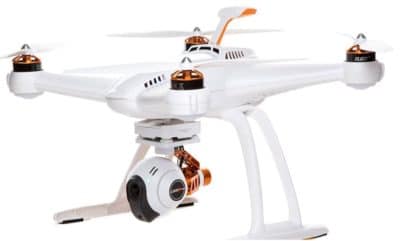
The frame is the skeleton. On a quadcopter it is usually an X or H shape with a motor at the end of each arm. Consumer drones use moulded plastic or composite bodies with folding arms, while FPV frames are cut from carbon fibre plates because they are stiff, light and survive crashes.
Arm length sets the maximum propeller size. Longer arms give more stability; shorter arms make a drone more agile. A stiff frame also matters for video, because flex lets motor vibration reach the flight controller and camera.
- Landing gear: small drones land on their belly or short feet; larger cinema and enterprise drones have tall legs, sometimes retractable, to keep the camera clear of the ground.
- Tip: after any hard landing, check the arm hinges and the motor mounts for hairline cracks before the next flight.
Propulsion: motors, propellers and ESCs
The propulsion system turns battery power into thrust. It has three parts that must be matched to each other and to the drone’s weight.
Brushless motors
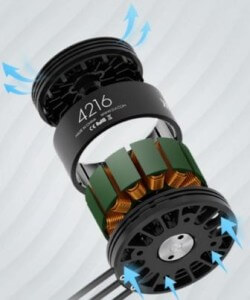
Almost all modern drones use brushless outrunner motors. A ring of magnets in the outer bell spins around fixed copper windings (the stator). With no brushes to wear, they are efficient and last for hundreds of hours. Motors are rated by stator size (for example 2207, meaning 22 mm wide and 7 mm tall) and Kv, the unloaded rpm per volt.
Propellers
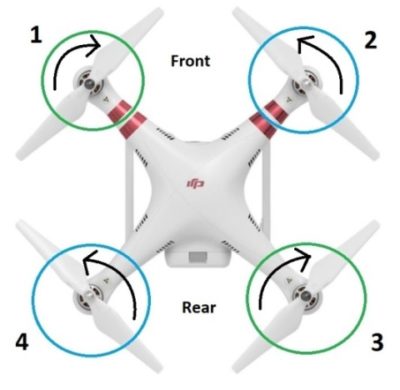
A quadcopter has two clockwise and two counter-clockwise props so their torque cancels out. Props are sized by diameter, pitch and blade count. Our guide to drone propeller direction and how a quadcopter flies explains the layout and how differential thrust steers the drone.
Electronic speed controllers (ESCs)
An ESC takes the battery’s DC power and switches it through the motor’s three windings in sequence, which keeps the motor turning at the speed the flight controller asks for. FPV drones typically use a single “4-in-1” ESC board for all four motors. Camera drones build the ESCs into the main board or arms. For the details, see our explainer on drone motors and ESCs.
Flight controller, IMU and sensors
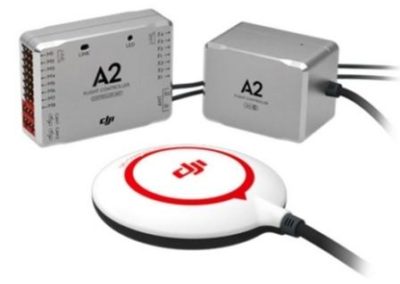
The flight controller is the drone’s brain. It is a small computer that reads the pilot’s commands and its sensors, then adjusts each motor many times a second to hold the drone level and on course. Without it, no human could fly a quadcopter.
- IMU: a gyroscope measures rotation and an accelerometer measures acceleration and the direction of gravity. Together they tell the controller the drone’s attitude.
- Barometer: measures air pressure to estimate altitude.
- Compass (magnetometer): gives heading, which GPS needs for position hold and return to home.
- Downward vision or ToF sensors: help the drone hover precisely and land when GPS is weak, such as indoors.
The gyro and the stabilisation loop are the most important pieces here. Our guide to drone gyroscopes, IMUs and flight controllers explains sensor fusion and PID control in plain terms.

GPS, radio links and antennas
GNSS module
Most camera drones use a multi-constellation receiver that tracks GPS plus systems such as Galileo, GLONASS and BeiDou. More satellites give a faster lock and steadier position hold. GNSS enables position hold, return to home, geofencing and automated flights. Read more in our guide to GPS and waypoint navigation.
Receiver, transmitter and video link
The receiver picks up commands from the remote controller. On camera drones, a single digital link carries control, telemetry and live video, so the “receiver” is built into the aircraft’s main board. FPV drones usually have a separate control receiver (ExpressLRS is now the most common protocol) and a video transmitter feeding goggles.
Antennas are small but critical. Bent, cracked or loose antennas cut range sharply. Keep them intact and point the controller’s antennas so their flat side faces the drone.
Battery and power system
Most drones run on lithium polymer (LiPo) packs, which deliver high current for their weight. Some camera drones use lithium-ion cells for longer flight times at lower power. Smart batteries on consumer drones include a management board that reports charge, temperature and cell health to the app.
- Voltage is set by cell count: 4S (four cells in series) is about 14.8 V nominal, 6S about 22.2 V.
- Store LiPos at about 3.8 V per cell if you will not fly for more than a few days. Smart batteries do this automatically.
- Never fly or charge a swollen, punctured or dented pack. Recycle it.
A power distribution board or the ESC spreads current to the motors, and a voltage regulator steps it down to 5 V or 3.3 V for the flight controller, receiver and camera.

Camera, gimbal and payload
On camera drones, the camera hangs from a gimbal: a set of small brushless motors and its own IMU that keep the lens level while the drone tilts and vibrates. Most current DJI camera drones, from the Mini 4K to the Mini 5 Pro, Air 3S and Mavic 4 Pro, use 3-axis gimbals. Smaller and cheaper models may use 1- or 2-axis gimbals plus electronic stabilisation.
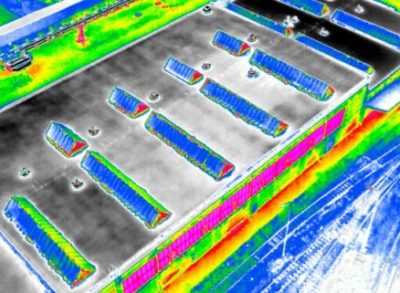
The main gimbal parts are the motors, an IMU, a control board, vibration dampers and the camera mount. Our guide to drone gimbal design and parts covers each one. Enterprise drones swap the camera for payloads such as thermal imagers, zoom cameras, multispectral sensors or lidar.
Obstacle sensing
Many mid-range and premium drones add vision cameras, infrared ToF sensors or small lidar units to detect obstacles. The DJI Mini 5 Pro, for example, combines omnidirectional vision with a forward lidar. Budget drones often have none, so they rely entirely on the pilot.
Building a drone: DIY parts list and tips
If you build your own, the classic choice is a 5-inch FPV quad. A typical parts list looks like this:
- Carbon fibre frame (5-inch, about 220 to 230 mm motor-to-motor)
- Four brushless motors (2207 or 2306 size)
- Flight controller and 4-in-1 ESC stack
- Control receiver (ExpressLRS is the usual choice)
- FPV camera and video transmitter, analog or digital
- Two or more sets of props, half CW and half CCW
- 4S or 6S LiPo batteries and a balance charger
- Match motor Kv to battery voltage: higher Kv for 4S, lower Kv for 6S.
- Soft-mount the flight controller to reduce gyro noise.
- Test motor direction in Betaflight with props off before your first flight.
- Use a smoke stopper the first time you power a new build, to catch a short circuit before it damages parts.
FAQs
What are the basic components of a drone?
A frame, motors, propellers, ESCs, a flight controller with an IMU, a battery, and a radio receiver. Camera drones add GPS, a compass, a gimbal and a camera. Those core parts are enough to make a multirotor fly and be controlled.
Which drone part is most likely to need replacing?
Propellers, by far. They chip on landing and crack in minor bumps, and a damaged prop causes vibration or loss of control. Batteries come next, as they wear out after a few hundred cycles. Carry spare props on every flight.
What is the difference between a flight controller and an ESC?
The flight controller decides how fast each motor should spin, based on stick input and sensor data. The ESC carries out that decision by switching battery power to the motor. One flight controller directs four or more ESCs.
Can I replace parts on a DJI drone myself?
Props, batteries and sometimes landing gear or arm covers are designed for user replacement. Motors, gimbals and main boards can be swapped with spare parts, but opening the drone may void the warranty. DJI Care Refresh or the official repair service is usually the safer option.