
Drone Motors Explained: How Brushless Motors, ESCs and Props Work
The motors and propellers are what actually lift a drone off the ground, and choosing the right combination decides how fast it flies, how much it can carry and how long the battery lasts. This guide explains how a drone’s propulsion system works: brushless motors, ESCs, propellers and batteries. It covers what motor numbers like 2207 and 1950KV mean, and how to pick the right motors for an FPV quad, a camera drone or a heavy-lift build.
Quick answer: Drones use brushless DC motors, each driven by an electronic speed controller (ESC). The flight controller tells each ESC how fast to spin its motor hundreds of times a second, and changing the speed of individual motors is how the drone climbs, turns and stays level. A motor’s size is written as four digits, for example 2207 (a 22 mm wide, 7 mm tall stator). Its KV rating is the RPM per volt with no load. Bigger props and higher-voltage batteries need lower-KV motors.
The parts of a drone propulsion system
- Motors: brushless outrunner motors convert electrical power into rotation.
- Propellers: they turn that rotation into thrust. Size, pitch and blade count change the character of the drone.
- ESCs (electronic speed controllers): they switch battery power to the motor coils in the right sequence and control speed.
- Flight controller: it reads the gyro, accelerometer and other sensors and sends speed commands to every ESC.
- Battery: usually a LiPo or Li-ion pack. Its voltage (cell count, written 4S, 6S and so on) and current capacity set how much power is available.
For an overview of every component, see our guide to the parts of a drone.
How brushless drone motors work
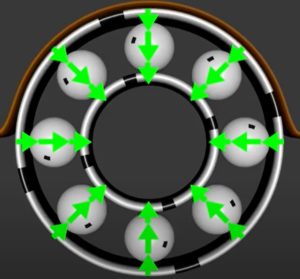
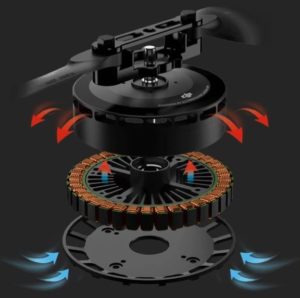
A brushless motor has a fixed inner part, the stator, wound with copper coils, and a rotating outer bell lined with permanent magnets. The ESC energises the coils in a rapid sequence, creating a rotating magnetic field that pulls the magnets, and so the bell, around. Because there are no brushes rubbing on contacts, brushless motors are efficient, powerful for their weight and last far longer than the brushed motors in toy drones.
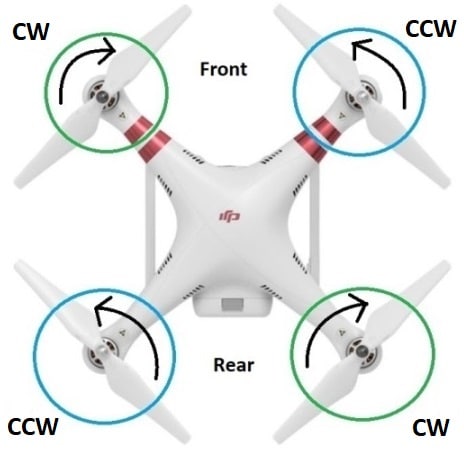
Each motor spins in a set direction, and on a quadcopter diagonally opposite motors spin the same way so their torque cancels out. Our guide to drone propeller direction shows the layout and explains how speeding up one pair makes the drone yaw.
Drone motor numbers explained: size and KV
Stator size: a motor described as 2207 has a stator 22 mm in diameter and 7 mm tall. A wider stator gives more torque, which helps to spin bigger or heavier props quickly. A taller stator gives more top-end power. A bigger stator means more power but also more weight.
KV rating: KV is how many RPM the motor turns per volt with no load. A 1950KV motor on a 6S battery (about 25 V) would spin at roughly 48,000 RPM unloaded. High-KV motors spin fast and suit small props and lower voltages. Low-KV motors produce more torque per amp and suit big props and higher voltages. KV is not a measure of power on its own. The right KV depends on prop size and battery voltage.
| Build | Typical prop | Typical motor | Typical KV |
|---|---|---|---|
| Tiny whoop / micro | 31–40 mm | 0702–1103 | 15,000–25,000 (1S) |
| 3-inch cinewhoop / toothpick | 3 in | 1404–1804 | 3,000–4,500 (4S) |
| 5-inch freestyle / racing | 5 in | 2207–2306 | ~2,400 on 4S, 1,700–1,950 on 6S |
| 7-inch long range | 7 in | 2806–2808 | 1,100–1,300 on 6S |
| 10-inch and larger / heavy lift | 10–30 in | 3115 and up | 100–900 on 6S–12S |
What an ESC does
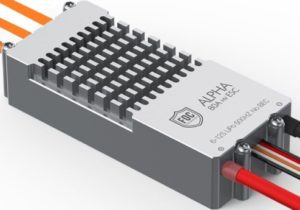
An electronic speed controller converts the flight controller’s throttle signal into precisely timed pulses of power to the motor’s three phases. Modern drones use digital protocols such as DShot, and firmware such as BLHeli_32, Bluejay and AM32. They support features like bidirectional DShot, which feeds motor RPM back to the flight controller for very effective noise filtering. On FPV quads the four ESCs usually sit on one 4-in-1 board stacked under the flight controller. Choose an ESC rated comfortably above your motors’ peak current, typically 45 to 60 A per motor for a 5-inch 6S build.
Propellers: size, pitch and blades
Props are described by diameter, pitch and blade count. A 5.1 × 4.5 × 3 prop is 5.1 inches across, would move forward 4.5 inches per turn in theory, and has three blades. More pitch gives more top speed but draws more current. More blades add grip and thrust but reduce efficiency. Camera drones use large, efficient two-blade props for long flight times. FPV pilots tune pitch and blade count for the feel they want.
How to choose drone motors
- Start with the frame and prop size. The frame decides the largest prop you can fit, and the prop decides the motor size.
- Pick your battery voltage. 6S is now standard for 5-inch FPV, and higher voltage lets you use lower-KV motors with less current and heat.
- Aim for a thrust-to-weight ratio of at least 2:1 for camera and cinematic drones, and 5:1 to 10:1 for freestyle and racing quads.
- Check the thrust tables. Reputable makers publish thrust, current and efficiency (grams per watt) for each prop and voltage.
- Match the ESC and battery to the motors’ peak current draw.
- Consider build quality: look for good bearings, strong magnets, unibell designs and titanium shafts if you crash often.
Popular drone motor brands
- T-Motor: a huge range, from Velox FPV motors to the MN and U-series for industrial and heavy-lift drones.
- iFlight XING: durable, popular FPV motors for freestyle and long range.
- BrotherHobby: well regarded for smooth, efficient freestyle and cinelifter motors.
- EMAX: affordable motors for beginner and micro builds.
- KDE Direct: premium motors and ESCs for professional multirotors and heavy-lift platforms.
Ready-to-fly camera drones from DJI, Autel and others use motors designed for that specific aircraft, so replacements should match the original part. Our drone repair guides cover common fixes by model.
Motor problems and maintenance
- Hot motors usually mean props are too big, KV is too high for the voltage, or filtering is poorly tuned.
- Grinding or rough spinning points to worn bearings, a bent shaft or debris between magnets and stator.
- A motor that twitches but will not spin often has a damaged winding, a loose solder joint or a failed ESC channel.
- Desyncs in flight, where a motor stutters at high throttle, are often fixed by updating ESC firmware or adjusting motor timing.
- Clean motors after dusty or sandy flights, check that screws are not touching the windings, and replace bent props straight away. Our drone repair and calibration guides cover specific models.
Drone motor FAQs
What does KV mean on a drone motor?
KV is the motor’s unloaded RPM per volt. A 2,000KV motor on a 10 V supply would spin at about 20,000 RPM with no propeller. It indicates speed, not power.
Is higher KV better?
Not necessarily. Higher KV suits smaller props and lower-voltage batteries. For bigger props and higher voltages, lower KV is more efficient and runs cooler.
What do the four numbers on a drone motor mean?
They are the stator size. The first two digits are the diameter and the last two the height, in millimetres. A 2306 motor has a 23 mm wide, 6 mm tall stator.
Can I put bigger motors on my drone?
Only if the frame, props, ESC and battery can support them. Bigger motors add weight and current draw, so upgrade the whole power system together.