
Thermal Drones in 2026: Best Thermal Cameras and How Thermal Imaging Works
A thermal camera lets a drone see heat instead of light. That means it can find a missing person in dark woodland, spot a failing solar panel or an overheating electrical joint, show where a roof is losing heat, or track wildlife at night. This guide explains how drone thermal imaging works, which specifications matter, and the best thermal drones and cameras in 2026, from compact inspection drones to flagship public safety aircraft.
Quick answer: Thermal drone cameras use an uncooled microbolometer sensor that detects infrared radiation, which every object gives off according to its temperature. The software turns those readings into a heat map. Most professional thermal drones use a 640 × 512 sensor, and the newest flagships, such as the DJI Matrice 5T and the Zenmuse H30T payload, step up to 1280 × 1024. For most inspection and search work the DJI Matrice 4T is the best all-rounder. The Mavic 3 Thermal is the most affordable proven option.
How thermal imaging works
Every object above absolute zero gives off infrared radiation, and the warmer it is, the more it emits. A thermal camera focuses that long-wave infrared (roughly 8 to 14 microns) onto a grid of tiny sensors called a microbolometer. Each pixel warms slightly when infrared hits it, and its electrical resistance changes. The camera measures those changes thousands of times a second and builds an image in which every pixel represents a temperature.
Because thermal cameras read emitted heat rather than reflected light, they work in total darkness and through light smoke and haze. They do not see through walls, glass or water. Glass reflects long-wave infrared, so you will see a reflection rather than what is behind a window. Shiny metals can also mislead, because they reflect the temperature of their surroundings. This property is called emissivity, and good radiometric software lets you correct for it.

Thermal camera specs that matter
- Resolution: 640 × 512 is the professional standard. 1280 × 1024 sensors show four times the detail, which lets you find a person or a hot component from further away. Budget 160 × 120 and 320 × 256 cameras are fine for close work but limiting from the air.
- Radiometric vs non-radiometric: a radiometric camera records a temperature value for every pixel, so you can measure spot temperatures and produce inspection reports afterwards. Non-radiometric cameras only show relative hot and cold.
- Thermal sensitivity (NETD): the smallest temperature difference the sensor can detect, quoted in millikelvin. Lower is better: under 50 mK is good, and under 30 mK is excellent.
- Frame rate: 30Hz gives smooth live video. Export-restricted versions are limited to 9Hz, which looks juddery when flying.
- Zoom and lens: a narrower thermal field of view, or digital zoom on a high-resolution sensor, lets you inspect from a safe distance.
- Paired visual camera: most thermal drones combine thermal with wide and zoom visual cameras and a laser rangefinder, so you can switch views or overlay them.

Best thermal drones in 2026
| Drone or payload | Thermal resolution | Flight time | Weather rating | Best for |
|---|---|---|---|---|
| DJI Matrice 5T | 1280 × 1024 | Up to 59 min | IP55 | Flagship public safety and inspection |
| DJI Matrice 400 + Zenmuse H30T | 1280 × 1024 | Up to 59 min | IP55 drone, IP54 payload | Long-range inspection, swappable payloads |
| DJI Matrice 4T | 640 × 512 (1280 × 1024 super-resolution mode) | Up to 49 min | None | Best all-rounder |
| DJI Mavic 3 Thermal | 640 × 512 | Up to 45 min | None | Entry-level professional thermal |
| Autel EVO Max 4T | 640 × 512 | Up to 42 min | IP43 | Non-DJI option with strong anti-jamming |
| Skydio X10 | 640 × 512 | Around 40 min | IP55 | US-made, NDAA-compliant fleets |
| DJI Dock 3 + Matrice 4TD | 640 × 512 | Up to 54 min | IP55 drone, IP56 dock | Automated, remote-operated sites |
DJI Matrice 5T: best flagship thermal drone
The Matrice 5T brings a native 1280 × 1024 thermal sensor to a portable, IP55-rated airframe. It is paired with three 50MP visual cameras, a long telephoto with up to 176x hybrid zoom, a 3 km laser rangefinder, and LiDAR plus mmWave radar for obstacle sensing in poor visibility. It flies for up to 59 minutes. It is the most capable all-weather thermal drone for police, fire and search teams, and a docked version (Matrice 5TD) supports automated drone-in-a-box operations.
DJI Matrice 4T: best all-round thermal drone
The Matrice 4T packs a 640 × 512 radiometric thermal camera, with a 1280 × 1024 super-resolution mode, into a foldable drone with wide, medium-tele and tele cameras. It adds a near-infrared auxiliary light for night search, a 1,800 m laser rangefinder and up to 49 minutes of flight. For most inspection, security and search-and-rescue teams it offers the best balance of capability, portability and price.
DJI Mavic 3 Thermal: best entry-level professional option
The Mavic 3T has a 640 × 512 thermal camera, a 48MP wide camera and a 12MP tele with 56x hybrid zoom. It flies for up to 45 minutes and offers omnidirectional obstacle sensing. It remains a popular, affordable choice for roof and solar inspections, agriculture and firefighting support. Newer teams may prefer the Matrice 4T, but the Mavic 3T is still widely used and supported.
DJI Matrice 400 with Zenmuse H30T: best for payload flexibility
For organisations that need to swap sensors, the heavy-lift Matrice 400 carries DJI’s Zenmuse H30T, which combines a 1280 × 1024 thermal camera, a 40MP zoom camera with 34x optical zoom, a 3,000 m rangefinder and an NIR light. The same aircraft can carry lidar, spotlights or speakers for other missions.
Autel EVO Max 4T and Skydio X10: non-DJI options
The Autel EVO Max 4T pairs a 640 × 512 thermal sensor with wide, zoom and laser rangefinder cameras, omnidirectional obstacle sensing and strong anti-jamming navigation. The US-built Skydio X10 uses a Teledyne FLIR Boson+ thermal core with autonomous flight and obstacle avoidance. It is often chosen by US government and public safety agencies that need NDAA-compliant drones.
Thermal cameras for custom drones
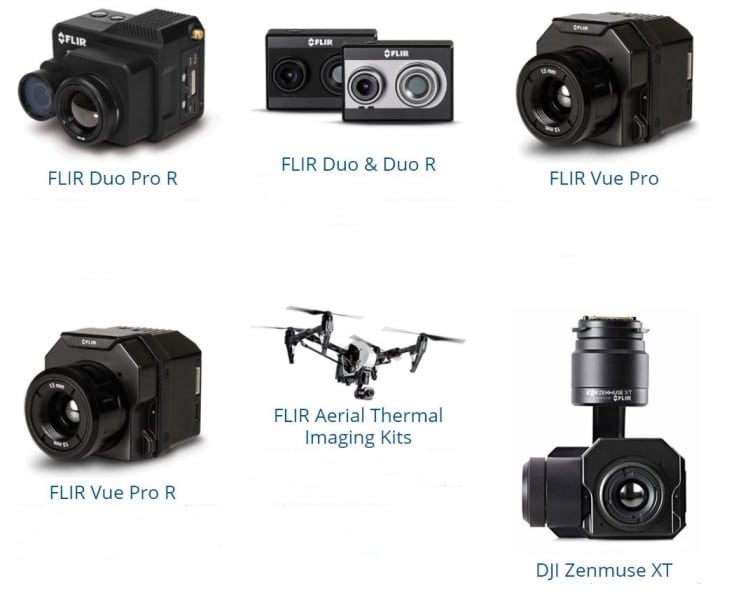
If you build your own drone, or need a payload for a third-party airframe, standalone thermal cores and cameras are available. Popular options include the Teledyne FLIR Boson+ and Hadron 640 modules, Workswell WIRIS radiometric cameras for professional inspection, and lightweight cores from InfiRay and others for FPV and small UAVs. Check radiometric support, frame rate and the export rules that apply in your country before buying.

Best uses for thermal drones
- Search and rescue: a warm body stands out clearly against cool ground at night, which shortens searches from hours to minutes.
- Firefighting: crews find hotspots through smoke and check for hidden embers after a fire is out.
- Solar inspection: faulty cells and bypass diodes show up as hot spots across whole solar farms in a single flight.
- Electrical and utility inspection: overheating joints, insulators and transformers can be found before they fail.
- Roofs and buildings: heat loss, wet insulation and leaks show up as temperature differences, best captured on cool, dry evenings.
- Agriculture: thermal imaging highlights crop water stress and irrigation problems. It is often paired with multispectral imaging.
- Wildlife and conservation: it is used to count animals and detect poachers at night. Read about anti-poaching drones.
- Security and law enforcement: perimeter patrol and tracking suspects in darkness.
Tips for better thermal drone results
- Fly at the right time: building and roof surveys work best after sunset or before sunrise, when solar heating has faded. Solar panel inspections need strong sunlight, ideally above 600 W/m².
- Set emissivity and distance correctly in radiometric mode before measuring temperatures.
- Lock the temperature range (isotherm or manual span) when comparing several images, so the colours mean the same thing in each.
- Watch for reflections from glass, water and shiny metal, which can show false hot or cold spots.
- Capture visual images alongside thermal so you can locate and explain every anomaly in your report.
For more on drone sensors, see our guides to lidar sensors and drone mapping.
Thermal drone FAQs
Can thermal drones see through walls?
No. Thermal cameras only see surface temperatures. They can show heat escaping through a wall, or the pattern of studs and wet insulation behind it, but not people or objects inside a building.
Can a thermal drone see at night?
Yes. Thermal imaging needs no light at all, which is why it is so effective for night search and security. Night flying may need extra permissions and anti-collision lighting, depending on your country.
What resolution thermal camera do I need?
640 × 512 is the professional standard for inspection and search. 1280 × 1024 lets you work from further away or cover more ground per flight. Lower resolutions are only suitable for close-range or hobby use.
How much does a thermal drone cost?
Professional thermal drones start at around $5,000 for a Mavic 3 Thermal. Matrice 4T and Autel EVO Max 4T packages typically run $7,000 to $9,000. Flagship and docked systems cost $10,000 to over $25,000.